📌 Save this post so you can quickly check the 5-Step Test the next time your child rides in the car.
Many parents wonder when their child can safely stop using a booster seat. While age is often used as a guideline, the most important factor is how the seatbelt fits the child’s body.
Vehicle seatbelts are designed for adults. Without a booster seat, the belt may sit incorrectly on a child’s stomach or neck, which can increase the risk of injury during a crash.
That’s why safety experts recommend using the 5-Step Test to determine whether a child is ready to use the vehicle seatbelt alone.
Booster seats raise children so that the seatbelt fits properly across the strongest parts of their body.
Without a booster seat:
The lap belt may ride up onto the stomach
The shoulder belt may cross the neck or face
Children may slouch or shift position to get comfortable
These situations can reduce the effectiveness of the seatbelt during a crash.
For many children, a booster seat is needed until around age 10–12, depending on their height and the vehicle’s seat design.
The 5-Step Test helps determine whether a child can safely ride using the vehicle seatbelt alone.
A child must pass all five steps.
You may want to save this guide so you can quickly check the 5-Step Test the next time your child rides in the car.
The child should be able to sit all the way back against the vehicle seat back.
If they need to slide forward to bend their knees comfortably, the seatbelt may not fit correctly.
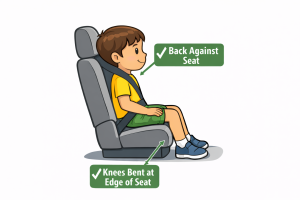
The child’s knees should bend naturally at the edge of the seat.
If their legs are too short and their feet don’t reach the floor, they may slouch to get comfortable, which can move the seatbelt out of position.
──────────────────────────────
Want more practical parenting tips like this?
Join other parents getting simple safety tips, helpful product recommendations, and real-life parenting advice for babies through young kids.
✓ Safety tips many parents don’t realize
✓ Parent-tested products that actually help
✓ Practical ideas you can use right away
Delivered every other week — no spam.
The lap belt should sit low across the upper thighs, not across the stomach.
This positioning allows the belt to rest on stronger bones rather than softer abdominal tissue.
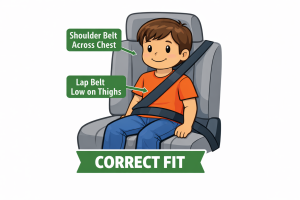
The shoulder belt should cross the middle of the chest and shoulder, not the neck or face.
If the belt rubs the neck, children often move it behind their back or under their arm, which reduces protection.
The child must be able to stay seated correctly for the entire trip.
This means:
sitting upright
keeping the belt in the correct position
not leaning forward or slouching
──────────────────────────────
Want more practical parenting tips like this?
Join other parents getting simple safety tips, helpful product recommendations, and real-life parenting advice for babies through young kids.
✓ Safety tips many parents don’t realize
✓ Parent-tested products that actually help
✓ Practical ideas you can use right away
Delivered every other week — no spam.
Many parents searching for the right booster seat age are surprised to learn that most children are not ready to ride without a booster seat until about age 10–12.
Height, vehicle design, and seat depth all influence how a seatbelt fits.
The best approach is to check seatbelt fit using the 5-Step Test, rather than relying on age alone.
If your child cannot pass all five steps, they should continue using a booster seat.
A properly fitted seatbelt is one of the most effective ways to protect children in a vehicle.
Taking a few moments to check the fit can make a meaningful difference in keeping kids safe on the road.
Every child grows at a different pace. When in doubt, continue using the booster seat until the seatbelt fits correctly.
Using the 5-Step Test can help parents make that decision with confidence and ensure the seatbelt fits safely.
Booster seats help position the seatbelt so it fits correctly across the strongest parts of the body.
Save this post so you can quickly check the 5-Step Test the next time your child rides in the car.